Interview with Professor Osman Bakar
May 23, 2024
[The following is excerpted from an interview with Professor Emeritus Datuk Dr. Osman Bakar, conducted by the Seikyo Shimbun and published in the paper on May 23, 2024. In January 2024, a memorial for SGI President Daisaku Ikeda (1928–2023) was held in Malaysia, where Professor Osman delivered a lecture. In this interview, he reflects on President Ikeda’s pioneering approach to dialogue that transcends cultural, civilizational and religious boundaries by highlighting the universal values shared by all humanity. (Interviewer: Hideki Hagimoto)]
Seikyo Shimbun: At the memorial event held in January 2024 by Soka Gakkai Malaysia (SGM) and the International Institute of Islamic Thought and Civilization (ISTAC) of the International Islamic University Malaysia (IIUM), you referred to Mr. Ikeda as an outstanding philosopher who advanced dialogue among people of diverse cultures and religions. How do you view his impact on the world and people today?

Professor Osman Bakar, Rector of the International Islamic University Malaysia
Professor Emeritus Datuk Dr. Osman Bakar: Mr. Ikeda's global impact was, first and foremost, at the level of ideas. His writings, especially his dialogues with prominent figures from both East and West, helped people to appreciate what I call “civilizational dialogue,” and understand its importance. Because he engaged directly with representatives of the world's major civilizations, his influence naturally extended across the globe.
However, for the global Soka Gakkai community and its many supporters worldwide, Mr. Ikeda’s influence extends far beyond the realm of ideas. There are countless individuals striving earnestly to put his philosophy into practice, and I have been deeply impressed by their strong discipline and unwavering commitment to bring the ideals to life.
Mr. Ikeda was also a thinker whose intellect transcended nations and cultures. This is evident in the way he addressed issues such as shared human dignity, peace, tolerance and cooperation in a manner that resonated with all humanity, using universal language that speaks across cultural, civilizational and religious boundaries.
This is particularly significant today, when societies remain deeply divided and preoccupied with sectarian issues. Decades ago, he might have been seen as a lone intellectual activist, especially from Asia, but now I believe his lifelong efforts are bearing fruit. Although our world is still divided, more and more people are beginning to recognize and value this new approach to global issues.
Seikyo: I understand that you first became familiar with Mr. Ikeda through his dialogue with the British historian Arnold J. Toynbee.
Osman: Yes, I was deeply impressed by Mr. Ikeda’s intellectual engagement in those discussions he had with Toynbee. Toynbee was a great historian who influenced many thinkers not only in the West but also in the East. Simply having such a figure as a dialogue partner naturally elevates the quality of the exchange, while at the same time placing significant demands on the interlocutor. Yet Mr. Ikeda succeeded in expressing his views with clarity and conviction.
I was a doctoral student in London when I first came across their dialogue Choose Life. As a philosophy major, I was drawn to Mr. Ikeda’s philosophical reflections. That encounter marked the beginning of my personal interest in him and his writings.
Mr. Ikeda did not separate philosophical reflection from spiritual or religious concerns, and that was important to me. At the time, I was studying works of Western thinkers such as Bertrand Russell, for whom philosophy was largely divorced from religion. But for us in the East, spirituality has always been an integral part of life. That's why Mr. Ikeda’s insights into global issues through a spiritual lens were especially appealing to me.
While his spirituality was rooted in Buddhism, his focus was on its universal dimensions. For that reason, I find that his ideas share common ground with other spiritual traditions of the world, including my own Islamic tradition.
Mr. Ikeda was not only a philosopher or a religious leader, but also an intellectual activist of remarkable energy. That was perhaps the aspect that impressed me most. In my view, Choose Life is one of the finest works I have ever encountered. I am deeply grateful to him for that.
Seikyo: You have also developed close ties with Soka Gakkai members in Malaysia and in other parts of the world. What are your impressions of them?
Osman: Although I had learned about the Soka Gakkai through Mr. Ikeda’s writings, my personal encounters with its members began in the 1990s. At the University of Malaya, where I served as Deputy Vice Chancellor, there was a Japanese student who was a member of the Soka Gakkai. Through him, I was given the opportunity to visit Soka University in Japan in the late 1990s.
After that, I was also invited to various events and activities hosted by Soka Gakkai Malaysia. Although my professional commitments prevented me from attending as many as I wished, the ones I did participate in—including those on environmental issues held at the University of Malaya—were all very impressive.
When the Malay edition of Mr. Ikeda’s dialogue with former Indonesian president Abdurrahman Wahid (The Wisdom of Tolerance: A Philosophy of Generosity and Peace) was published, I was invited to write the foreword, which I gladly accepted. I read the book closely in preparation, and I was truly impressed and deeply grateful for the dedication and discipline of the SGM members who supported the project. Not only that, I was also honored to deliver a special address at Mr. Ikeda’s memorial in January 2024, which brought me even closer to the Soka Gakkai members in Malaysia.
Seikyo: What impressions did you have of Mr. Ikeda’s dialogue with former President Wahid?
Osman: It was a dialogue between two towering figures—representatives of the Buddhist and Islamic worlds. They discussed a wide range of important themes, and what is significant is that they viewed these not merely as Asian concerns but as issues of universal concern. It is also noteworthy that these two Asian intellects were able to share so many commonalities and points of convergence.
I personally knew President Wahid. He was greatly admired in the Muslim world for his openness and tolerant spirit. The wisdom of tolerance, which was the central theme of the dialogue and is reflected in the book’s title, is also a value that has long been cherished in Islamic tradition.
When the Prophet Muhammad established Islam in the seventh century in the city of Medina, tolerance toward diverse peoples and religions became a defining characteristic of the community. Since then, Islam has contributed to the development of pluralist societies, offering ways for multi-ethnic and multi-religious communities to live together in harmony.
The same wisdom of tolerance is also found in Buddhism. The Buddhist perspectives that Mr. Ikeda presented in the dialogue are grounded in universal values shared by Islam, Christianity, Hinduism and other traditions.
I should add that the Malay translation of the dialogue was done by my friend, Professor Dr. Md Sidin Ahmad Ishak, who serves as vice president of Malaysia Board on Books for Young People. It is an excellent translation of superb quality.
Seikyo: In 1996, you established the Centre for Civilizational Dialogue at the University of Malaya. Could you share what led to this initiative and its purpose?

Professor Osman delivering the inaugural memorial lecture in January 2024 in honor of Daisaku Ikeda, who passed away in November 2023.
Osman: Just a few months earlier, the University of Malaya had hosted an international conference on civilizational dialogue. At the time, I had just been appointed Deputy Vice Chancellor, but I was already involved in many dialogue-related activities. The event was officially launched by Anwar Ibrahim, who was then deputy prime minister and is now the prime minister of Malaysia. Anwar and I had been schoolmates, sharing a strong interest in civilization and dialogue. With the support of the government, we were able to hold the conference on a large scale.
This was at the height of the controversy stirred by Samuel Huntington’s infamous theory on the “clash of civilizations.” His argument that Islam and Confucianism would join forces to confront the West provoked widespread criticism around the world, including in Malaysia. I also reject that view. The spirit of Islam is rooted in dialogue, not confrontation, and the notion of uniting against the West is simply far too simplistic.
In Malaysia, where Chinese Malaysians form the second largest community after Malays, Islam and Confucianism have coexisted for centuries. Yet despite this long history of coexistence, there had been little serious dialogue between them.
To counter the perception that Islam and Confucianism could hardly engage in meaningful dialogue, we invited representatives of both traditions to the conference. Among the participants was Professor Tu Weiming, the renowned Confucian scholar from Harvard University. The discovery of many shared values between the two traditions came as a welcome surprise to the participants. Immediately after the success of the conference, I took the initiative to establish the Centre for Civilizational Dialogue.
In 2021, the Centre celebrated its 25th anniversary, and it continues to be an active institution. It remains a key hub for civilizational dialogue not only in Malaysia but across Southeast Asia.
Seikyo: As a distinguished Islamic philosopher, you have written actively on Islam’s role in globalization. Could you share your thoughts on this role and its significance?
Osman: The Quran speaks of the unity of the human family. Islam presents itself as a synthesis of all the previous scriptures. The question here is, what unifies humanity? It's not race, not materialism, but spirituality. It’s what the Quran calls God consciousness, inherent in all human beings. In this sense, the Quran is a universal scripture that reaffirms the truth embodied in all the previous scriptures.
After the death of the Prophet Muhammad, Islam expanded rapidly both eastward and westward, and people became increasingly aware of its global character. One of the pillars of Islam is the pilgrimage to Mecca, where each year millions of people of diverse races and ethnicities gather. Mecca is not only a spiritual center but also a cultural crossroads, helping to foster a spirit of globalism.
However, the reality is that many of Islam’s positive contributions have been overshadowed by distorted perceptions. In the contemporary Muslim world, incidents related to various forms of extremism have occurred, and because such extremism and violence receive heavy media attention, the many constructive and humane aspects of Islam are not widely known.
Of course, there are extremists who commit violent acts in the name of Islam. But it is essential to understand that the overwhelming majority of Muslims neither support nor condone any form of extremism. I hope that a deeper understanding of Islam will spread throughout the world, with greater attention given to its core teachings rather than its politicized interpretations.
The purpose of civilization is to know one another. The Quran teaches that humanity was divided into nations and tribes so that we might come to better understand each other. For centuries, Islam has served as a bridge between Eastern and Western civilizations, strengthening the spirit of globalism by sharing its rich legacy of knowledge and humanistic values.
Mr. Ikeda also drew a clear distinction between religions that divide people and those that unite them. He dedicated his life to the latter—to efforts that bring humanity together in solidarity.
Seikyo: Soka Gakkai members continue to uphold Mr. Ikeda’s spirit by dedicating themselves to dialogue and mutual understanding for the peace and happiness of humanity. What are your impressions of their efforts?
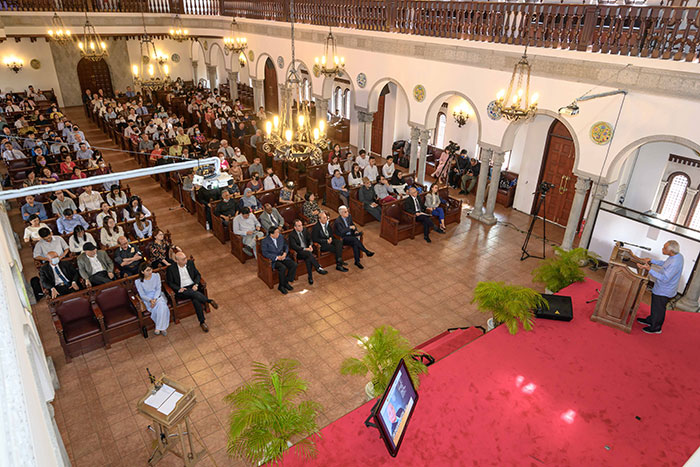
The second Daisaku Ikeda Memorial Lecture held in January 2025 at the International Islamic University Malaysia (IIUM), co-hosted by Soka Gakkai Malaysia and the International Institute of Islamic Thought and Civilisation at IIUM
Osman: As I mentioned earlier, I have long witnessed and admired the discipline, dedication and commitment of Soka Gakkai members. What I hope is that they will carry on the fine tradition established by Mr. Ikeda and not only deepen their understanding of his thought but also put it into practice. More than understanding, it is through action that his philosophy truly comes alive.
Soka Gakkai members have contributed greatly to society through their diverse activities. What underlies these efforts are the ideals of Mr. Ikeda and those of his two predecessors, Tsunesaburo Makiguchi and Josei Toda.
I sincerely hope they will continue to move forward with confidence and sincerity in their service to humanity. Our world needs people like them. I also hope they will expand their collaboration with groups around the world that share the same ideals.
We must join hands in the pursuit of peace and justice. I believe Soka Gakkai plays an important role in connecting people from diverse backgrounds across the globe.
Osman Bakar was born in Malaysia in 1946. A renowned Islamic philosopher, he has been listed among the 500 most influential Muslims in the world. In 1996, he established the Centre for Civilizational Dialogue at the University of Malaya. In September 2024, he was appointed rector of the International Islamic University Malaysia (IIUM). He is also an emeritus professor and holder of the Al-Ghazali Chair of Epistemology and Civilizational Studies and Renewal at the International Institute of Islamic Thought and Civilization (ISTAC-IIUM). Professor Osman actively promotes dialogue for peace and coexistence in Malaysia’s multiethnic, multireligious society. He is the author or editor of 40 books and more than 300 articles on various aspects of Islamic thought and civilization, particularly Islamic science and philosophy—fields in which he is recognized as a leading authority.
Share this page