Interview with Professor Anita Patterson
May 16, 2025
[The following is excerpted from an interview with Professor Anita Patterson of Boston University, USA, conducted by the Seikyo Shimbun and published in the paper on May 16, 2025. A leading scholar of American and African American literature, Professor Patterson has long explored the connections between the thought of Emerson and other American Renaissance figures and Buddhist philosophy. In this interview, she shares her insights on the power of literature and dialogue to foster inner change and illuminate a path forward in a world increasingly marked by division, drawing on Daisaku Ikeda’s philosophy and example. (Interviewers: Toshiaki Kakegawa and Susumu Murakami)]
Seikyo Shimbun: You specialize in American and African American literature and have also explored the relationship between American Renaissance literature and Buddhism. Could you tell us how you first encountered literature, and what drew you to it?
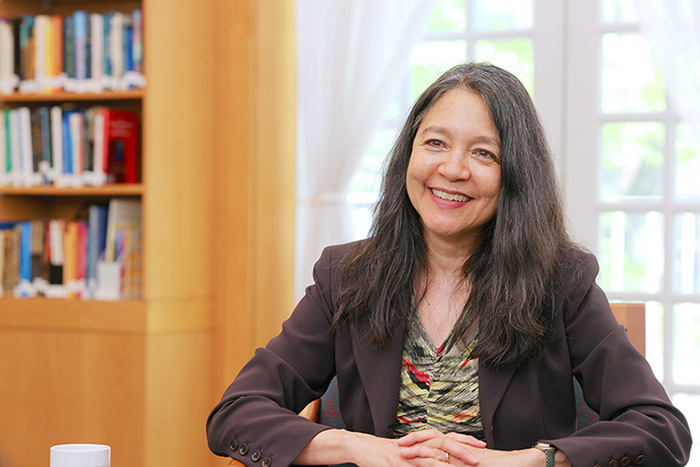
Anita Patterson, Professor in the Department of English at Boston University, USA
Professor Anita Patterson: I grew up grappling with the challenge of feeling “different” within American society. I was raised in an immigrant family—my mother was Japanese American, with roots in Hiroshima Prefecture, and my father was a descendant of Russian Jews.
During World War II, my mother, then a high school student, was incarcerated in a Japanese American internment camp after being classified as an “enemy alien.” In her family lineage, there were both Christians and Buddhists. However, I did not learn that members of our family were practicing Buddhists until I began researching the history of Japanese Americans. My mother never spoke about her faith or about her experience of incarceration.
At the same time, my mother, who loved books, was a great role model for me. For her, reading was also a way to learn about culture and tradition, and an effort to find her place within American society.
I grew up in a complex environment, with cultural roots in the United States, Japan, and Russia, and religious influences that included Christianity, Judaism and Buddhism. Perhaps for this reason, I developed a strong longing to bridge the distance between myself and others and to feel at home within America’s cultural traditions. This desire ultimately became the source of my passion for literature.
As I studied writers such as Emerson and Thoreau, central figures of the mid-19th-century American Renaissance, I became increasingly interested in the points of resonance between their thought and Buddhism. In fact, Emerson and his circle took a deep interest in Buddhist philosophy and studied it closely.
At the time, Emerson stood at the center of a new philosophical and literary movement known as Transcendentalism. Its proponents were drawn to the conviction that each human being inherently possesses great potential. In 1836, Emerson and his colleagues formed the Transcendental Club, and later launched their journal, The Dial.
Together with Thoreau, Emerson introduced translations of classical Eastern scriptures in the journal and, in 1844, published an English translation of the “Parable of the Medicinal Herbs” chapter of the Lotus Sutra. This parable describes the diverse capacities of living beings who are nurtured by the Buddha’s compassion and teachings, each according to their ability and need.
Emerson’s writings helped bridge the cultural gaps in my own life and in my family history. My engagement with literature was both an exploration of my family’s past and a journey toward discovering my own identity.
Seikyo: You have participated many times in forums organized by the Ikeda Center for Peace, Learning, and Dialogue in Cambridge, Massachusetts, where you have spoken about the power and value of literature.
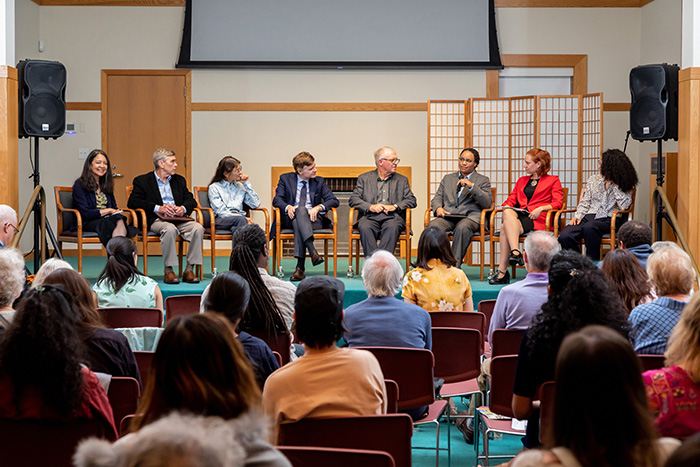
Professor Patterson (left, on stage) participating in a forum hosted by the Ikeda Center in Cambridge, Massachusetts, USA (September 2023)
Patterson: Through these events, I studied Daisaku Ikeda’s writings and received profound inspiration. He frequently quoted literature in his speeches and writings, using its power to encourage countless people.
I myself came to truly understand the power of literature during a most difficult and painful period in my life. In the mid-1990s, just as I was establishing myself as a scholar, my older sister took her own life. My grief was beyond words.
What role can literature play in people’s lives during times of grief? Since then, I have devoted myself to exploring the power of literature in a modern society confronted by so many challenges. The thought of Emerson and other figures of the American Renaissance affirms the inherent worth of the self. It offers a wellspring of wisdom that renews the human spirit and illuminates the meaning of life.
This also resonates deeply with Buddhist thought. In a 1993 lecture at Harvard University, Mr. Ikeda quoted Emerson’s words: “the universal beauty, to which every part and particle is equally related; the eternal One.” Reflecting on Emerson’s idea of the “Over-Soul,” Mr. Ikeda spoke of the Buddhist way of life of the “Greater Self,” which calls us to be true to ourselves—unswayed by external influences—while cultivating boundless empathy and understanding for others.
Emerson argued that a truly great person is a nonconformist, one who is not swayed by the currents of society, and he taught self-reliance with the words, “Trust thyself.” Reading his essay Self-Reliance during the darkest period of my life helped me overcome profound hardship. As I continued to read his work, I came to see my own life within a larger context.
Mr. Ikeda, through the Buddhist concept of the greater self, also spoke of how each individual can develop great character and live proactively while remaining true to oneself. His poems and writings have consistently given me courage and the strength to live. As he suggests, this is also a process of deeply reflecting on one’s inner self. My parents struggled as immigrants in American society. For me, as their daughter, literature gave me the strength to find meaning in life and to be spiritually renewed as a human being.
Seikyo: In September 2023, the Ikeda Center hosted a forum titled “Dialogues of the Heart: The Role of Literature in Fostering Inner Transformation and Peace,” where you delivered a keynote address.
Patterson: In his message to the forum, Mr. Ikeda pointed out, from the perspective of Mahayana Buddhism, that the roots of division and conflict lie in a disorder of thought and spirituality. To overcome such conditions, he emphasized the importance of inner transformation, describing the power of literature as the wings that guide us toward a “universal self” lying deep within our lives. He further stressed that learning from the literature each country treasures and sharing the emotions it inspires lead to a dialogue of the heart that nurtures both inner transformation and peace.
I have always been impressed by Mr. Ikeda’s approach of drawing lessons from literature. Through literature, we can engage in dialogue with cultures and ways of thinking different from our own.
In his long poem “Arise, the Sun of the Century,” Mr. Ikeda describes conversing with Emerson and Whitman as “old friends,” writing:
Since my youth, years ago,
Emerson and Whitman have been
my constant companions.
We have talked together—a dialogue of the heart.
In the English translation, this is rendered as “a dialogue of the heart,” expressing how engagement with literature becomes an open-hearted dialogue that transcends differences in ethnicity, culture and religion.
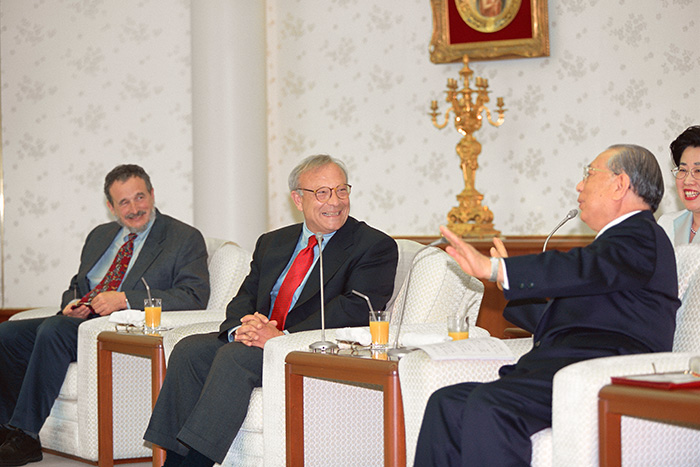
Mr. Ikeda meeting with Professors Ronald A. Bosco (center) and Joel Myerson (left), with whom he collaborated on Creating Waldens. (Soka University, Tokyo, May 2001)
Mr. Ikeda also includes Thoreau in this dialogue of the heart. In his dialogue with Ronald Bosco and Joel Myerson (Creating Waldens : An East-West Conversation on the American Renaissance), he introduces the poem “The Triumph of the Human Spirit,” in which he writes:
Ralph Waldo Emerson,
Henry David Thoreau,
Walt Whitman—
ceaselessly issue the generous
cry of their souls,
a call redolent with the
vastness of nature,
into the endless firmament
of humanity.
Reading literature helps us overcome the many differences that divide us. This is why I feel a deep resonance with Mr. Ikeda’s idea of the dialogue of the heart.
In life, there are days when we cannot even rise from bed in the morning. It is precisely at such times that literature and dialogue reveal their true worth. They allow us to find meaning in life, build better relationships with others and elevate our own existence.
When we can feel hope in life and in society, the world begins to shine with meaning for us. Even in the most difficult circumstances, we can grow into individuals who wish to contribute to both our own happiness and that of others.
Seikyo: Today, the world faces many serious conflicts. What value do you see in literature and dialogue in an age of deepening divisions?
Patterson: I believe the world today is suffering from a lack of hope. People seem to be losing faith in democracy, and that troubles me deeply.
In the United States, the Civil Rights Movement of the 1960s saw African Americans striving to overcome racial discrimination. Even then, society was divided by war, economic inequality and discrimination. Yet people around me inspired hope by demonstrating that actions such as voting, civil disobedience and protest were effective means of transforming society for the better.
Today, however, dialogue between people with differing views has become increasingly difficult due to self-righteous anger and extreme partisanship. Some media outlets have described this condition as a “rage epidemic.” The combination of anger and the absence of dialogue is having devastating effects throughout society.
This brings me back to Mr. Ikeda’s thought and practice. For me, one of the most profound and striking insights in his lifelong efforts to build a better global society is the concept of hope.
Mr. Ikeda writes, “Hope . . . is a decision. It is the most important decision we can make. Hope changes everything, starting with our lives. Hope is the force that enables us to take action to make our dreams come true.” He teaches us that the world is a struggle between hope and despair, and that peace is achieved when hope prevails.
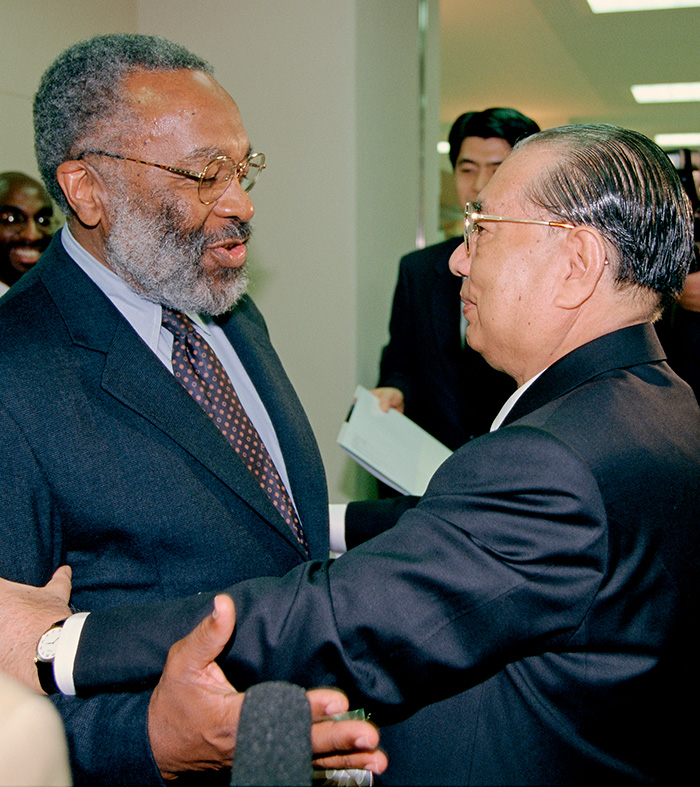
A reunion between Dr. Vincent Harding and Mr. Ikeda (Soka University, Tokyo, April 1996)
In his dialogue with Dr. Vincent Harding, historian and close friend of Martin Luther King Jr. (America Will Be!: Conversations on Hope, Freedom, and Democracy), Mr. Ikeda affirmed that “As long as we still have this dream, hope remains eternal.”
My goal as an educator is to share this philosophy of hope with my students. In my university literature courses, I place great importance on cultivating students’ historical self-awareness. Studying historical developments through literature is a first step toward bridging divides of culture, race and class.
For example, studying African American literature helps students understand the legacy of slavery and racism and how these histories continue to shape present-day society. When confronting difficult political issues, differing views often clash. Yet by engaging in dialogue through literary works in the classroom, students can discuss their differences openly and thoughtfully, without direct confrontation.
Literature and dialogue remind us that there is always more we can learn from others. Dialogue that fosters closeness is an essential practice in everyday life, cultivating deep awareness and understanding of ourselves and others. I believe this process is closely connected to peacebuilding.
In his 2004 Peace Proposal commemorating SGI Day, Inner Transformation: Creating a Global Groundswell for Peace, Mr. Ikeda wrote:
“Peace is not some abstract concept far removed from our everyday lives. It is a question of how each one of us plants and cultivates the seeds of peace in the reality of daily living, in the depths of our being, throughout our lives. I am certain that herein lies the most reliable path to lasting peace.”
Each time I study Mr. Ikeda’s writings and way of life, I feel a renewed life of hope breathe into me. I believe the sustained, grassroots practice of dialogue carried out by members of the Soka Gakkai holds profound significance in leading contemporary society forward. I sincerely hope that such a movement will bear fruit and bring Mr. Ikeda’s vision into reality.
Anita Patterson is Professor in the Department of English at Boston University, USA. Her research focuses on American literature, modernism, and Black poetry of the Americas, with particular attention to transnational and intercultural dialogue. Her published works include the book From Emerson to King: Democracy, Race, and the Politics of Protest. Her current book project, American Japonisme and Modernist Style, further explores her interest in transnationalism, intercultural exchange and the American contexts of literary modernism. In 2021, she contributed the chapter “Restoring Hope for the Humanities: Daisaku Ikeda, Intercultural Study, and College Classroom Experience” to the volume Hope and Joy in Education: Engaging Daisaku Ikeda Across Curriculum and Context.
Share this page