The Light That Continues to Shine
[The following is excerpted from an interview with Neelakanta Radhakrishnan, a renowned Indian social activist and chairman of the Indian Council of Gandhian Studies, conducted by the Seikyo Shimbun and published on November 19, 2025. Dr. Radhakrishnan, who has spent many years exploring Daisaku Ikeda’s philosophy, reflects on their encounter and shares his expectations for the Soka movement worldwide. (Interviewer: Kenta Toyoizumi)]
Seikyo Shimbun: You once described Mr. Ikeda as a “living Gandhi.” It has been two years since his passing. Could you share your reflections?
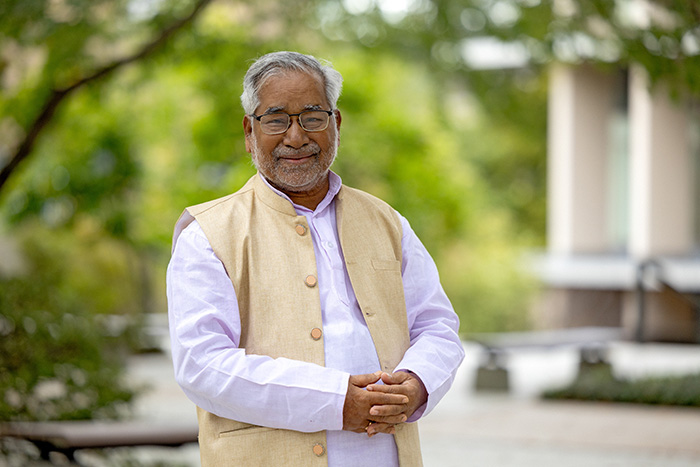
Neelakanta Radhakrishnan, Chairman of the Indian Council of Gandhian Studies
Dr. N. Radhakrishnan: Gandhi was taken from us by gunfire. His assassin likely believed that with this act Gandhi was gone. But this was not the case.
After Gandhi’s death, his disciples inherited and carried on his spirit. His legacy continued to grow even stronger, exerting a profound influence on human history. I believe the same can be said of President Ikeda’s passing.
Around the world today, many institutions and organizations are devoted to the study of President Ikeda’s thought. Scholars and leaders in many countries continue to learn and engage with his philosophy and spirit. And it is not only members of the Soka Gakkai—many people with no connection to the organization are also seriously studying President Ikeda’s life and ideas.
The great light President Ikeda radiated will continue to shine into the future as a steady beacon. I am convinced that his thought will exert an even greater influence on human history in the years ahead. It does not feel, even for a moment, that he is no longer with us.
Seikyo: You met President Ikeda on several occasions. Could you share some of your memories?
Radhakrishnan: I first met him in 1984, when I came to Japan to attend an international seminar at Soka University. Someone introduced me as a young Gandhian scholar from India. At the time, I was merely a young and unknown researcher, yet he greeted me with his palms together, saying “Namaste,” and treated me with the utmost sincerity and respect. Such a person, able to establish an instant communication, felt to me like an invitation to a new world. For someone who had devoted many years to the study of Gandhi, it was the moment a new path opened before me. Through his words and conduct, I became convinced that this was the person who embodied Gandhi’s spirit in the modern age—someone who would shape the future of humanity.
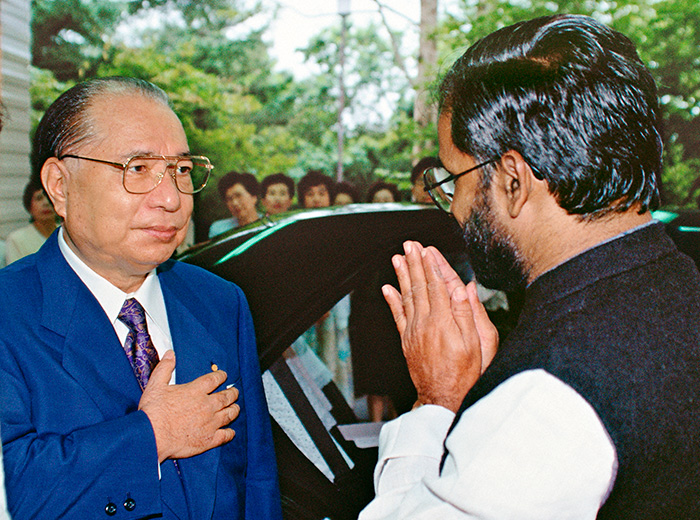
Meeting between Dr. Radhakrishnan and President Ikeda (Nagano Prefecture, Japan, August 1993)
After that, we met many times over the years, but the meeting that remains most vivid in my memory took place in 1993 in Karuizawa, Nagano. We shared many thoughts about how humanity should act to achieve world peace. Our conversation also turned to the absolute evil of war—how wars are instigated by a handful of leaders, while it is the ordinary people who suffer the most. That is why, President Ikeda insisted, we must change the mindset of leaders who rush toward violence.
He viewed the world with a broad, global perspective, while firmly believing that everything begins with the inner transformation of the human heart. At one point, he picked up a sheet of manuscript paper and asked me, “Dr. Radhakrishnan, can you tell what I have written here?”
Written on it were the words: “Nothing is more precious than peace. Nothing brings more happiness. Peace is the most basic starting point for the advancement of humankind.”
That was the first page of the manuscript of The New Human Revolution, which he had begun writing that very day. I personally regard The Human Revolution and The New Human Revolution as a blueprint for humanity’s peace. They set forth a grand vision of how humanity can live in peace.
I believe they were written not only for those who long for peace, but also as a message to leaders who steer others toward war. In the future, I believe that these novels will stand alongside the great classics of world literature. And the day will surely come when President Ikeda’s contributions to peace are recognized even more highly. He is a figure who shows us how we should live.
What I understand as the “philosophy of human revolution” is, at its core, the awakening to one’s own mission. Many young people are unaware of their mission. But once a person awakens to it, tremendous energy is unleashed, and genuine value creation becomes possible.
Seikyo: In 2002, you established the Ikeda Centre for Value Creation. In an increasingly uncertain world, how can we carry forward Gandhi’s spirit of nonviolence and Mr. Ikeda’s philosophy of peace? And what value can Soka philosophy offer society?
Radhakrishnan: Alongside Mahatma Gandhi and Martin Luther King Jr., who fought tirelessly for human rights, President Ikeda was a figure who brought transformation to society and delivered new light to humanity. Their lives and philosophies represent humanity’s ultimate hope. I established the Centre to share this message with the wider world.
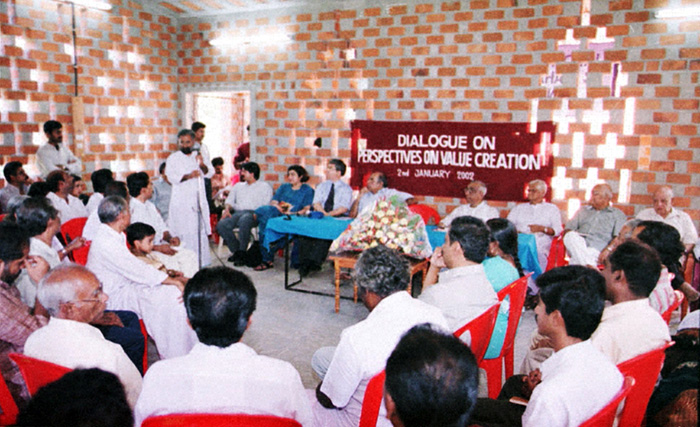
Dr. Radhakrishnan giving a talk at the opening of the Ikeda Centre for Value Creation (Kerala, India, January 2, 2002)
I have devoted many years to the study of Gandhi. Since meeting President Ikeda, I have learned so much and have written nearly twenty books about him. Yet my work is far from complete. In the time that remains in my life, I want to devote myself even more fully to researching his thought through the Ikeda Centre for Value Creation. I want to share what I have learned—my knowledge and experience—with children, young people and women. There is still so much that I must do.
At the foundation of human history lie human qualities such as sincerity and love. These essential human qualities can only be passed on through close, genuine interaction between people. I believe the mentor–disciple relationship plays a vital role in this process. President Ikeda revived this concept in the modern age.
Gandhi’s spirit of nonviolence and civil disobedience continues to live strongly within our hearts even today. In these turbulent times, President Ikeda’s philosophy of peace likewise deepens within us as we walk the path of mentor and disciple.
Across the world, members of Soka Gakkai worldwide are united in a grassroots movement grounded in the mentor-disciple relationship. Within the Soka Gakkai, people from diverse backgrounds come together and work side by side, regardless of position or status. This in itself is remarkable. Among the members I have met, many are making a real impact in their respective communities. That driving force comes from within each individual. Through my encounters with them, I came to understand that a single person can truly bring about change. This is nothing less than proof of human greatness.
There are three books I always carry with me. One of them is the English edition of President Ikeda’s A Youthful Diary. Whenever I travel or face personal struggles, I open this book and draw great courage from the struggles of his youth. For me, President Ikeda’s writings are a vast treasury of wisdom and insight.
During his lifetime, President Ikeda established numerous institutions dedicated to peace, culture and education. Soka Gakkai centers now exist around the world, and he has inspired countless disciples. Even after his passing, these disciples continue to create powerful causes for transforming the destiny of humankind. Through their efforts, I firmly believe that President Ikeda’s wisdom and compassion will continue to embrace the world for eternity.
Seikyo: Today, the youth of Soka around the world are boldly walking the path of mentor and disciple. How do you view the global development of the Soka Gakkai?
Radhakrishnan: Through my many interactions with members of Bharat Soka Gakkai (BSG), President Ikeda came to place his trust in me and, to my surprise, named me Honorary Chairperson. This made a profound impression on me—his trust in young people, his deep care for them, and his commitment to fostering new talent. Having observed the development of BSG up close, I have also been deeply impressed. What moves me most is that so many young people are striving to follow their mentor’s way of life, even though they have never met him in person.
I have also taken a keen interest in the development of women leaders in BSG. Learning the spirit of mentor and disciple is not a matter of academic study; it is something one acquires through daily practice aimed at the happiness of both oneself and others.
The Soka Gakkai’s activities around the world, beginning with BSG, represent an invaluable movement for humanity and serve as a powerful force for building a better society. They also continue to nurture individuals who make meaningful contributions to their communities.
I believe President Ikeda consistently emphasized that building a world without war depends on the younger generation creating value. He placed his hopes in youth to build societies where justice flourishes and there is no place for discrimination.
Even today, conflict remains rampant around the world, and those in power seek to assert their nation’s strength. Amid such widespread egoism, President Ikeda emphasized the importance of spirituality, values, morality and religious awareness. These elements are essential to realizing a sustainable world.
He taught us to respect one another, to embrace cultural diversity, to honor religious pluralism and to deepen understanding of gender. He also taught us not to judge people by their background or circumstances, but to value their humanity above all else. Throughout his life, he showed us the importance of living with conviction, courage and confidence—and of never giving up, no matter what happens.
When society confronts great difficulties and must overcome them together, it needs the means to do so. President Ikeda provided those means in many ways, through dialogue, education and culture.
I also once served as a guest editorial writer for the Seikyo Shimbun. In the years ahead, I believe the newspaper’s mission of sharing President Ikeda’s philosophy of peace with the world will become even more vital.
Gandhi, too, was once a journalist. Through newspapers, he used the power of the pen to convey his philosophy of nonviolence to the younger generation.
As we conclude this interview, I would like to share a message with the Soka youth across the globe who will shape the future:
Have unshakable conviction in President Ikeda’s philosophy and actions. Now, more than ever, let us take up the challenge he embodied—to turn the impossible into the possible—for the sake of realizing world peace.
Neelakanta Radhakrishnan was born in 1944 in Kerala, India, and earned a Ph.D. in the literature of social protest from Annamalai University. He subsequently joined the Gandhigram Rural Institute, where he worked under G. Ramachandran, a close associate of Mahatma Gandhi. From 1990 to 2001, he served as director of Gandhi Smriti and Darshan Samiti in New Delhi. He has founded several peace and educational institutions, including the G. Ramachandran Institute of Nonviolence, the Gandhi Media Foundation, the Sabarmati Center for Naturopathy and Yoga, and the Ikeda Centre for Value Creation. A leading authority in Gandhian studies, he has authored more than 75 books in English, Hindi, Tamil and Malayalam on Gandhian philosophy, peace education and nonviolent conflict resolution. In 2008, he received the Rajiv Gandhi National Sadbhavana Award, and in 2018, he became the first Indian to receive the Gandhi, King, Ikeda Community Builders Prize.
Share this page