Carrying Forward Wahid and Ikeda’s Legacy of Dialogue
[November 15, 2025, marked the second anniversary of President Daisaku Ikeda’s passing. The late Abdurrahman Wahid (1940–2009), Indonesia’s fourth president from 1999 to 2001, remains deeply revered by the people. He engaged in a rich spiritual exchange with Mr. Ikeda, including co-authoring the dialogue The Wisdom of Tolerance: A Philosophy of Generosity and Peace. The Seikyo Shimbun interviewed former First Lady Sinta Nuriyah, who observed her husband’s life and work at close hand. The interview appeared in the November 14, 2025, issue. (Interviewers: Kenichi Ono and Tetsuya Ishizuka)]
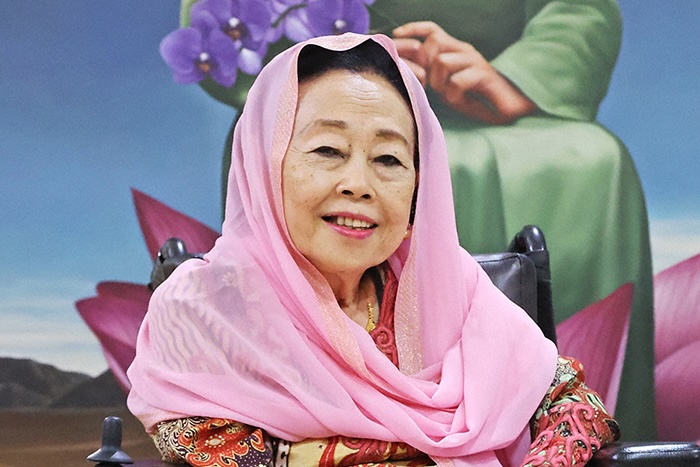
Sinta Nuriyah, former First Lady of Indonesia
Seikyo Shimbun: In Indonesia, home to the world’s largest Muslim population, former President Abdurrahman Wahid (1940–2009)—who embodied the ideal of religious coexistence and was beloved by many—was supported over many years by you. Even after his passing in December 2009, his ideals have continued to spread and garner strong support. You were present at the meeting between Mr. Ikeda and former President Wahid in April 2002, and have since deepened your ties, including through participation in events of Soka Gakkai Indonesia.
Former First Lady Sinta Nuriyah: Gus Dur (the affectionate name for former President Wahid) had long wished to meet Mr. Ikeda. He read and reread Daisaku Ikeda’s dialogue with the historian Arnold Toynbee, Choose Life: A Dialogue, hoping for the day they might meet.
Transcending the selfish mindset of “as long as I am well, that is all that matters,” one awakens to their identity as members of humanity and of the universe.Therein lies the true role of religion. Gus had deeply engraved in his heart the philosophy set forth in that dialogue.
Seeing firsthand the profound trust he placed in Mr. Ikeda left a deep impression on me as well.
Following his meeting with Mr. Ikeda in 2002, Gus Dur renewed his determination to dedicate the remainder of his life even more fully to the people. From that encounter onward, he acted with even greater vigor for the happiness of others.
Seikyo Shimbun: Former President Wahid was the first president elected through democratic procedures since Indonesia’s independence and was also a leader of Nahdlatul Ulama, the country’s largest Islamic organization, with more than 90 million members. What were the core beliefs that guided him?
Nuriyah: What we valued most were three principles: humanity, tolerance and democracy. We faced many challenges—political pressure, misunderstandings, threats and even acts of terror. Gus Dur’s life was repeatedly in danger. Yet no matter the circumstances, we never let go of these three values.
This was because we believed these three principles to be the very foundation of Indonesia’s national unity and harmony. Humanity is both a guiding ideal of the nation and the core of our faith. In the teachings of Islam as well, respect for human dignity is upheld as the highest virtue.That is why we pledged to uphold these three principles throughout our lives.
Seikyo Shimbun: You have lived a modest life while continually striving for the happiness of the people. How did you support your husband amid the turbulence of political life?
Nuriyah: My struggle was to protect the family. So that Gus Dur could devote himself to his public duties with peace of mind, I worked to keep our home calm and to ensure that our children could grow and learn in a healthy environment. Even in times of financial hardship, I took care not to show my anxiety. I would always tell our children, “You are blessed.” In that way, Gus Dur could focus on his responsibilities without distraction. That was the greatest support I could offer and the mission I embraced.
Seikyo Shimbun: In 1998, former President Wahid suffered a stroke and lost his eyesight. You yourself have been living in a wheelchair since a traffic accident in 1993. How have you faced and navigated these challenges?
Nuriyah: I have always turned to Allah in prayer, entrusting everything to him. “If we do what is right, Allah will surely show us the way. Even if we lose our way, he will guide us back.” This is the belief by which I have lived. No matter how difficult the circumstances, I do not remain bound by my own limited thinking. I first turn to Allah. This has been the source of my strength.
Gus Dur, too, accepted that “everything Allah grants has meaning.” He continued to encourage himself, saying, “I will simply do my best.” He never once lamented his fate and remained forward-looking to the very end.
The most difficult time was in 2001, when, amid political pressure, Gus Dur was removed from the presidency. Those were truly painful days. Yet I said to him, “The position of president is something granted by Allah. So when it is taken away, that, too, is by his will. Now is the time to accept it in the best possible way. Surely, beyond this, Allah’s blessings await.”
Gus Dur nodded quietly. He said nothing at the time, but a few days later, with a brighter, more untroubled expression, he said, “This, too, is a mission entrusted to me.” He then declared that he would continue striving for democratization. Once again, his heart was filled with a renewed pride in dedicating his life to the people.
Seikyo Shimbun: Former President Wahid’s philosophy has had a profound impact on shaping religious diversity in contemporary Indonesia. His commitment to multiculturalism has drawn international attention for the important insights it offers into how people of different backgrounds can coexist. From your perspective, which aspects of his philosophy are most needed today?
Nuriyah: Gus Dur believed that dialogue gives people a “human face.” That conviction guided him throughout his life. During his presidency, when conflict between Christians and Muslims led to many casualties, he, undeterred by danger, immediately traveled to the affected island. Despite receiving threats that bombs had been planted, he did not back down. As an Islamic leader, he offered a heartfelt apology to Christian representatives and appealed for understanding, insisting that “only through dialogue can people truly come to understand one another.”
He also made sustained efforts to build relationships with countries and individuals who kept their distance from religion. At the heart of Gus Dur’s actions was a single aim: to safeguard the welfare of society and the happiness of the people, and to find ways to connect people to one another. That was all.
Seikyo Shimbun: What ideals do you believe were shared by former President Wahid and Mr. Ikeda?
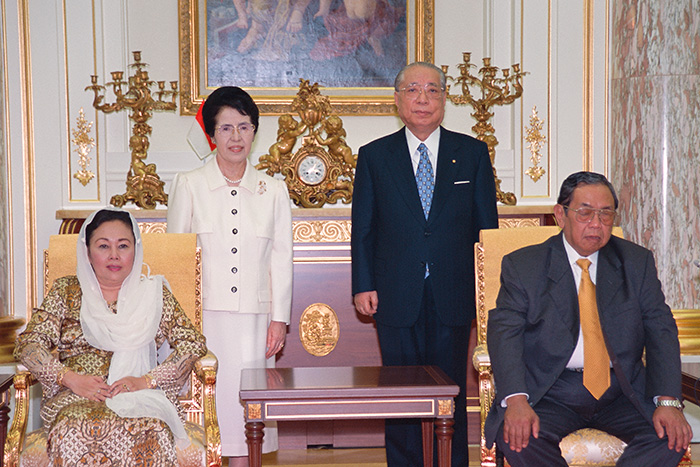
Former Indonesian President Abdurrahman Wahid and former First Lady Sinta Nuriyah with Mr. Ikeda and his wife, Kaneko Ikeda, at the Makiguchi Memorial Hall. (Tokyo, April 2002)
Nuriyah: Without a doubt, it is “humanism.” More than any politics or any system, placing the human being at the center—this was their shared starting point. Transcending religion and ethnicity, they placed respect for the individual first. Not fearing differences, but seeking common ground and building bridges from there—this is the essence of dialogue among civilizations and the path to peace.
At their meeting in 2002, Mr. Ikeda quoted an Indonesian proverb, “If you lose your way, go back to the starting point,” and said, “Like Islam, Buddhism is fundamentally oriented toward peace. Tsunesaburo Makiguchi, the founding president of the Soka Gakkai, would often say, ‘When you reach an impasse, return to the starting point.’ The ‘starting point’ to which humanity must now return is peace. All religions should cooperate on this single point of peace.”
Seikyo Shimbun: Following the meeting, they agreed to publish their dialogue in book form, and their “dialogue between Islam and Buddhism” continued through an exchange of letters. I understand that this continued until shortly before former President Wahid’s passing in December 2009. In 2010, The Wisdom of Tolerance: A Philosophy of Generosity and Peace was published in Japanese and later released in eight languages, including Indonesian.
Nuriyah: What left a particularly strong impression on me in the dialogue was the word “civilization.” For both Gus Dur and Mr. Ikeda, civilization did not refer to buildings or technology, but to human beings themselves. To understand others, to respect them and to live together—this, they said, is the very core of civilization. When there is human dignity and compassion, even our differences can be a source of value. I feel this is a philosophy that is indispensable in today’s world.
Gus Dur devoted extraordinary care to his exchange of letters with Mr. Ikeda. Amid his days traveling throughout Indonesia, people seeking to meet him came without pause from morning until night. In truth, the time when he could most calmly prepare those letters was when he was in the hospital. During the roughly three hours of dialysis, he would look forward to writing his response. Though it was time that took a toll on his body, it was also a deeply fulfilling time of dialogue for him.
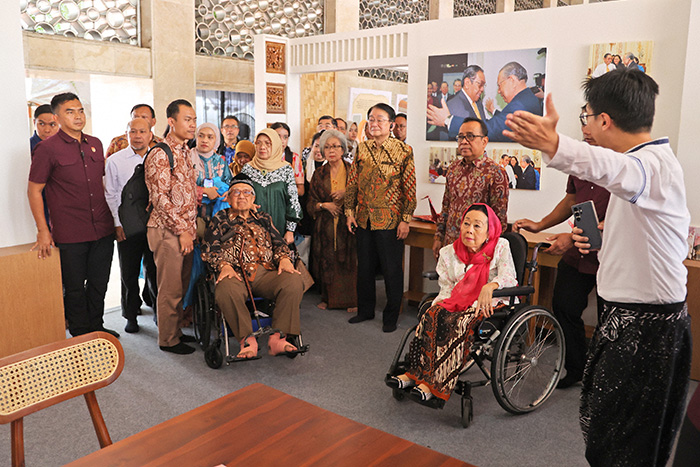
Sinta Nuriyah attends an exhibition highlighting the friendship and exchanges between Abdurrahman Wahid (Gus Dur) and Daisaku Ikeda, held under the theme “A Dialogue of Civilizations” at the Istiqlal Mosque. (Jakarta, Indonesia, October 1, 2025)
Seikyo Shimbun: On October 1, 2025, an exhibition titled “A Dialogue of Civilizations,” highlighting the friendship and exchanges between former Indonesian President Abdurrahman Wahid and President Daisaku Ikeda, opened at Istiqlal Mosque in Jakarta. It was later held at the University of Indonesia and other venues through November 7, drawing a strong response.
Nuriyah: I am truly delighted that an exhibition conveying the “dialogue of the heart” between Mr. Ikeda and Gus Dur has been held. I sincerely hope that the spirit of dialogue will be passed on to younger generations and continue to resonate through society.
It seems to me that, with the passage of time, their dialogue has only deepened in significance. Amid a world shaken by confusion and division, I sincerely hope that the message—“Let us engage in dialogue that lights one another’s way, so we may move forward together, hand in hand”—will come to shine in each person’s heart. Their dialogue is truly a “prescription for tomorrow”—a source of light through which humanity can once again reflect on what it means to be human. To do all I can to ensure that this light is passed on to the next generation—that, I believe, is my mission.
Seikyo Shimbun: All four of your daughters have gone on to pursue paths of social contribution.What was your approach in raising them?
Nuriyah: I did not provide any special form of education. But I was always mindful that I myself was an example for my children. How to respond to those who are struggling or in need—this is something I wanted them to learn not through words, but by watching me. Raising children is not something done with money. It is done through prayer and with the heart.
I grew up as the eldest of eighteen siblings and, from an early age, learned how to share with others. From that experience, I came to believe that education is about nurturing the heart. I have always believed in education and in the power of women.
As I travel and speak at various venues, I tell young mothers: “Your kindness and patience will transform society through your children.” True courage lies in kindness and patience. That strength finds its fullest expression through faith.
Today, the world is deeply wounded by war and division. But I have not lost hope.
If women unite their hearts and expand dialogue within their communities, the world will surely change. For each woman to establish her own dignity and bring her inner potential to full bloom—this was a conviction that Mr. Ikeda and Gus Dur cherished throughout their lives, and a theme that formed the conclusion of their dialogue.
Peace begins in our homes. It begins in our hearts. The prayers and actions of a single woman will, in time, transform society.
Seikyo Shimbun: What is the spirit of former President Wahid and Mr. Ikeda that we must carry on today?
Nuriyah: To respect one another and engage in dialogue with hope in our hearts—that is what it comes down to. What they shared was the conviction that, while each religion upholds its own tenets, it must also ask how it can contribute for the sake of peace, the people and society. Never forgetting that starting point and continuing to act without fear—this, I believe, is the mission entrusted to us and the greatest gift we can offer to the future.
The dialogue efforts that members of the Soka Gakkai carry out around the world are a true sharing of the spirit of peace. Gus Dur, I myself, and all of you who walk together with Mr. Ikeda are fellow companions united in spreading this spirit of peace.
I pray from the bottom of my heart that the spirit of peace and tolerance left by Mr. Ikeda and Gus Dur will continue to live on in people’s hearts, shining as a steady light in each person’s life. I also pray that an era of humanism will spread, in which all people everywhere can find pride and joy in their lives.
Sinta Nuriyah was born in 1948 in Jombang, East Java. She is the wife of the late Abdurrahman Wahid, Indonesia’s fourth president. A prominent women’s rights activist, she was left paralyzed from the waist down in a traffic accident in 1993 but has continued her social engagement with great vigor. She later earned a master’s degree in women’s studies from the University of Indonesia. In 2000, she established a foundation dedicated to advancing the rights of women and children. She has been actively engaged in promoting interfaith dialogue and gender equality. In 2018, she was named one of Time magazine’s “100 Most Influential People in the World.”
Share this page