Interview with Dr. José Trinidad Padilla López
March 3, 2026
[The following is excerpted from an interview with José Trinidad Padilla López, former rector general of the University of Guadalajara in Mexico, conducted by the Seikyo Shimbun and published in the paper on March 3, 2026. Marking 45 years since Daisaku Ikeda delivered a commemorative lecture at the university, Padilla López reflects on the role of education and dialogue in fostering global citizens, the importance of humanism in building a sustainable society and the need to inspire young people to work for peace. (Interview by Teruaki Kimura)]
Seikyo Shimbun: As an alumnus of the University of Guadalajara, you have devoted many years to the university’s development. What inspired you to pursue a career in education?
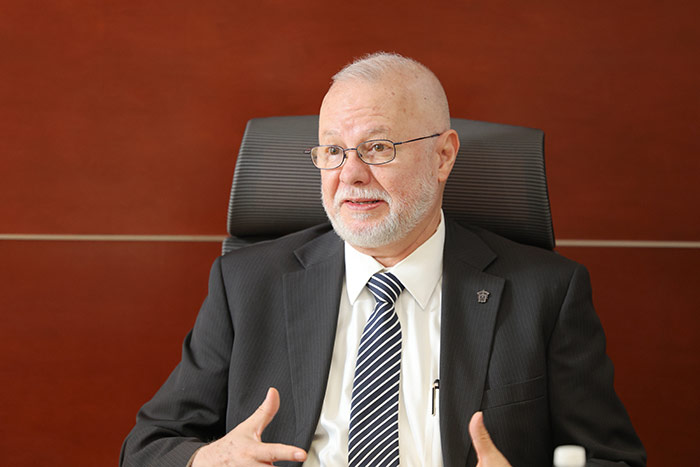
José Trinidad Padilla López, former rector general of the University of Guadalajara, Mexico
Former Rector General José Trinidad Padilla López: During my student years in the 1970s and 1980s, violence was widely used as a means of control in many Latin American countries. Civil wars in Nicaragua, El Salvador and elsewhere claimed countless precious lives, while repression under military rule continued in Chile. Living in an age when violence bred further violence, I became keenly aware of the importance of building peace through dialogue.
The University of Guadalajara is a leading institution of higher education that embodies its guiding principle, “Think and Work,” and has devoted itself to fostering individuals who contribute to civil society. I came to believe that educating a generation of young people committed to humanism, in keeping with this principle, was the path to peace. That is why I chose to work at my alma mater.
I later learned that Dr. Ikeda had delivered a lecture at the University of Guadalajara. [In March 1981, Daisaku Ikeda delivered a commemorative lecture at the university titled “Mexican Poetic Spirit.”] As it happens, I was a second-year university student at the time. I learned that, in his lecture, Dr. Ikeda spoke of the bonds he had forged with Mexican intellectuals through dialogue. I could not help but feel that I shared a profound connection with him.
Seikyo Shimbun: Since its founding in 1792, the University of Guadalajara has developed into one of Mexico’s foremost institutions of learning. Today, including students in its High School Education System, it has an enrollment of more than 350,000 and has produced many graduates who contribute to society. What educational principles guide the university?
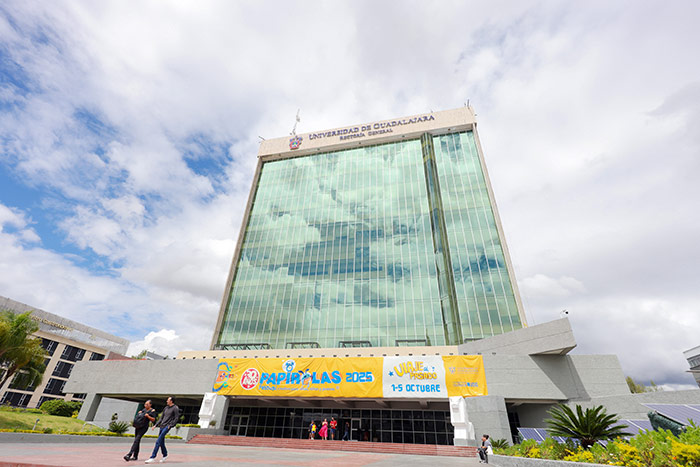
The University of Guadalajara, founded in 1792, is one of Mexico’s oldest universities.
Padilla López: We aim to foster students with a global outlook who can transcend cultural differences and connect with people from all backgrounds through dialogue. When people engage in dialogue with understanding and respect for other cultures, friendship is born. I believe that the “capacity for dialogue,” which enables us to expand networks around the world, is the true “competitiveness” that should be cultivated. In other words, in addition to acquiring skills and knowledge, it is essential to foster individuals with a broad perspective and the human qualities needed to bring people together.
Seikyo Shimbun: What do you believe is necessary to cultivate these human qualities?
Padilla López: I currently serve as director of the Juan José Arreola Jalisco State Public Library, which is part of the University of Guadalajara system. In this role, I have once again been reminded of the importance of reading. Students can cultivate a rich humanity not only by deepening their knowledge in their chosen fields but also by encountering unfamiliar forms of art and culture through reading. Personally, I would like them to read literary classics by authors such as France’s Victor Hugo, as well as poetry—the art of literature, one might say—which expresses profound meaning in just a few words.
I also believe that an appreciation of music is essential to the formation of one’s character. At the Juan José Arreola Library, we currently offer children’s programs that include storytelling sessions, theatrical performances and choral activities.
Seikyo Shimbun: In September 2004, the University of Guadalajara conferred an honorary doctorate on Mr. Ikeda. Could you explain why the university chose to bestow this, its highest honor, on him and what significance the conferral held?
Padilla López: The month before the conferral ceremony, the University Council, comprising university leaders, faculty members and students, convened to consider the matter. The council recognized that, as a distinguished educator, poet and philosopher, Dr. Ikeda had made significant contributions to peace over many years, including his efforts toward the abolition of nuclear weapons, and had demonstrated outstanding leadership in advancing that cause. It therefore voted unanimously to confer an honorary doctorate on him.
In his acceptance remarks at the conferral ceremony, Dr. Ikeda offered guiding principles that could serve as a beacon for humanity.
At a time when the world is in turmoil and violence is widespread, I cannot help but wish that Dr. Ikeda were still with us. At the same time, precisely because he has passed away, I feel that it is now our responsibility to share his ideas with the world.
Seikyo Shimbun: You first met Mr. Ikeda at the honorary doctorate conferral ceremony held at Soka University in Hachioji, Tokyo.
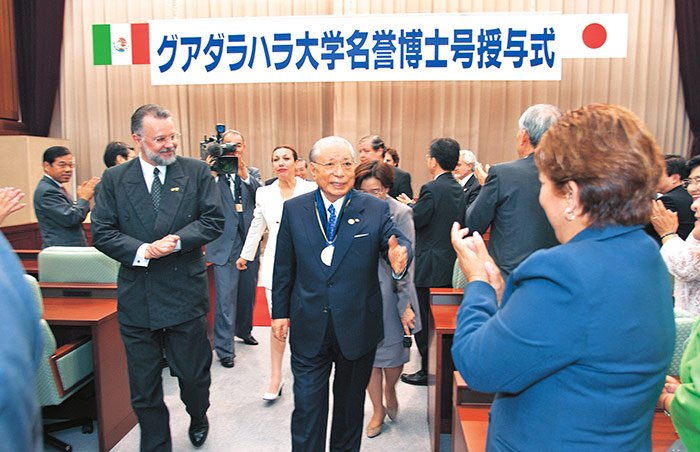
Dr. Padilla López (left) walking alongside Mr. Ikeda (center) following the bestowal on Mr. Ikeda of an honorary doctorate by the University of Guadalajara (Hachioji, Tokyo, September 2004)
Padilla López: Even today, I can still vividly remember how, when the elevator doors opened as we arrived at the venue, Dr. Ikeda and his wife, Kaneko, were standing there to welcome us warmly. Before the ceremony, I had been very nervous because I had the strong impression that Japanese culture involved many formalities and protocols.
Yet Dr. Ikeda, never losing his gentle smile, created a warm and relaxed atmosphere that put everyone at ease. Although the ceremony itself was solemn and dignified, his remarks, delivered with touches of humor, truly brightened the atmosphere.
Before the conferral ceremony, we viewed an exhibition on the history of Soka education. I was deeply impressed to learn how Tsunesaburo Makiguchi and Josei Toda, the first two presidents of the Soka Gakkai, stood up against militarism, and how, under Dr. Ikeda’s leadership, the organization has grown into a major movement dedicated to building peace.
Seikyo Shimbun: At the honorary doctorate conferral ceremony, you stated that “education truly has the power to transform an age.” In addition to founding Soka University, Mr. Ikeda established a comprehensive educational system extending from kindergarten through university and devoted himself to fostering global citizens. How would you assess his contributions to education?
Padilla López: The system of Soka education established by Dr. Ikeda contains many elements from which educational institutions around the world can learn. It is an admirable educational system that instills a culture of peace, respect for the dignity of life and respect for humanity.
The following year, in 2005, our university signed an academic exchange agreement with Soka University. During my tenure as rector general, we also established exchange agreements with a number of universities in Asia. I believe that international student exchanges are extremely important in promoting intercultural understanding.
Seikyo Shimbun: The world today is in an “age of crisis,” facing numerous challenges, including recurring conflicts, climate change and widening divisions. In this context, what significance do you believe Mr. Ikeda’s philosophy holds?
Padilla López: The present day is often described as the “age of social media,” marked by rapid advances in the internet and other information and communication technologies. Yet even as these technologies are expected to expand human connections, the number of people experiencing isolation appears to be increasing. In such an age, we need a philosophy that affirms the importance of human connection, teaches the capacities people must develop—such as dialogue and cooperation—and promotes resilience, the ability to overcome adversity.
Dr. Ikeda’s philosophy can indeed be regarded as a profound humanism capable of cultivating precisely the qualities people need to develop. The term “humanism” does not mean that humanity should dominate the Earth. On one occasion, as I looked through a book of Dr. Ikeda’s photographs, I was struck by the beautiful natural landscapes it portrayed. Humanism, as Dr. Ikeda envisions it, extends beyond valuing human beings alone; it also entails protecting the entire environment in order to build a sustainable world.
In 2014, a number of high schools within our university’s High School System hosted “Seeds of Hope,” an environmental exhibition jointly created by the SGI and Earth Charter International. World peace is indispensable to building a sustainable global society. Going forward, I hope to organize lectures and other events to help spread Dr. Ikeda’s humanistic philosophy.

A street scene in Guadalajara, capital of the state of Jalisco (left); an aerial view of the city (right)
Seikyo Shimbun: In 2023, the Juan José Arreola Library hosted “Everything You Treasure—For a World Free From Nuclear Weapons,” an exhibition jointly created by the SGI and the International Campaign to Abolish Nuclear Weapons (ICAN).
Padilla López: I also attended the exhibition, which drew a great many visitors from across the region. I was particularly struck by how intently so many young people and high school students viewed the exhibition. Afterward, I asked one young participant what he thought. He replied, “Until then, I had no idea how nuclear weapons could be abolished, but seeing the exhibition helped me envision how it might be possible.”
Even in Mexico, relatively few people are aware that if even one country were to initiate a nuclear war, it could lead to the destruction of the entire planet. That is why I believe movements that appeal to people’s conscience by raising awareness of the threat nuclear weapons pose to humanity are so important.
Seikyo Shimbun: You once said, “The future of humanity unquestionably depends on the education of young people.” What message would you like to share with the younger generation who will shape the future?
Padilla López: First, I hope young people will read widely and deeply. Reading great books helps cultivate one’s conscience. I also want to tell them not to isolate themselves. I hope they will connect with others through dialogue.
And as fellow human beings living on this planet we call Earth, I hope they will embrace a humanism aimed not at creating a world in which humanity alone prospers, but at building a truly sustainable society. I sincerely hope they will live without allowing ego rule them and take responsibility for helping to build that future.
José Trinidad Padilla López was born in 1957. After graduating from the University of Guadalajara, he held various positions at the university, including director of educational outreach programs and secretary general. In 2001, he became rector general. He currently serves as president of the Guadalajara International Book Fair and director of the Juan José Arreola Jalisco State Public Library.
Share this page